
East Midlands · England
Gas safety certificate (CP12) in Loughborough
What you need: A yearly gas safety check of the gas appliances and flues you provide, by a Gas Safe registered engineer, with a copy of the record (CP12) for your tenants.
Also covering: Woodhouse, Seagrave, Swithland.
How often: Every year: a check by a Gas Safe registered engineer.
Free to use · No sign-up · Always check their registration before you book · Search another town or postcode
Landlord rules that apply in Loughborough (England)
- Every year: a check by a Gas Safe registered engineer.
- Within 28 days: give your tenants a copy (new tenants get it before they move in).
- Keep it: hang on to records for at least 2 years.
- Renters’ Rights Act 2025: England-only reforms (assured periodic tenancies from 1 May 2026). Overview on GOV.UK.
- Local licensing (Charnwood): mandatory HMO licensing applies (5+ people, 2+ households sharing facilities). Confirm any selective or additional scheme for your postcode with Charnwood council.
Short local summary — not legal advice. Full Gas safety (CP12) rules by nation · Free landlord guides · GOV.UK landlord safety responsibilities
Request a gas safety certificate in Loughborough
No gas safety engineer listed here yet. Tell us what you need and we'll find you a registered gas safety engineer, free. Request a gas safety certificate
Check they're registered: Gas Safe Register
Local tips for Loughborough
Mostly mains gas round here
Most homes in Loughborough run on mains gas, so a standard boiler-and-hob check is what most people need.
Where's this from?
ONS Census 2021, Loughborough: 81.3% mains gas onlyBusy rental market: book early
Lots of people rent in Loughborough, so if you're letting, book a few weeks before a tenancy starts or renews. No last-minute panic.
Where's this from?
ONS Census 2021, Loughborough: 25.2% private rented vs 20.5% EnglandRenting in Loughborough: the local picture
81.3% of Loughborough households rely on mains gas only for central heating, above the England figure of 74.0%.
Only 0.7% use oil or tank/bottled gas, so most landlord checks here are on mains gas boilers, fires and hobs.
Homes in Loughborough: 23.5% detached, 36.4% semi-detached, 22.5% terraced and 14.4% purpose-built flats (England: 22.9%, 31.5%, 23.0% and 17.1%).
17.9% of 23,770 households rent from a council or housing association, against 17.1% across England.
Source: ONS Census 2021 (town figures).
| Type | Share | Households |
|---|---|---|
| Mains gas | 81.3% | 19,300 |
| Two or more | 8.2% | 1,941 |
| Electric | 7.3% | 1,734 |
| Oil / LPG | 0.7% | 164 |
| Other / none | 2.5% | 603 |
Source: ONS Census 2021 (TS046) — Loughborough built-up area, Charnwood. OGL v3.
Getting to know Loughborough
Loughborough is in the Charnwood council area, in the East Midlands. On the council's ward map it takes in Loughborough East, Loughborough Outwoods & Shelthorpe, Loughborough Ashby, Loughborough Storer, Loughborough Southfields, Dishley, Hathern & Thorpe Acre, Loughborough Woodthorpe and Loughborough Nanpantan wards.
Postcode-wise, Loughborough spans 2 districts: LE11 (Charnwood), about 22,336 households; LE12 (East Leake, West Leake, Sutton Bonington and Mountsorrel), about 25,869 households (2011 Census households, via Doogal). The same districts also take in Barrow upon Soar, Belton, Bunny, Burton on the Wolds, Charley, Charnwood, unparished area, Costock, Cotes, East Leake, Hathern, Hoton, Kingston on Soar, Long Whatton and Diseworth and Mountsorrel, so a gas safety engineer covering Loughborough will often know those streets too.
Living just outside? This page also covers the smaller places nearby: Woodhouse (~2 miles south), Seagrave (~6 miles east) and Swithland (~4 miles south).
Next-door postcode districts: NG9 (Beeston); NG11 (Clifton); LE3 (Braunstone); NG10 (Long Eaton); LE19 (Narborough); DE74 (Castle Donington).
Ward by ward, Loughborough isn't all the same. Of its 8 main wards, private renting is highest in Loughborough Southfields (43% of households) and lowest in Loughborough Outwoods & Shelthorpe (13%). For homes heated by mains gas only, Loughborough Nanpantan leads (89%) and Loughborough East has the fewest (75%). (ONS Census 2021, output areas summed to 2025 wards inside the town.)
Want more choice? The nearest bigger towns are Leicester (~10 miles south) and Nottingham (~14 miles north), and Gas Safe registered engineers based there may travel.
How old are the homes? Council tax records put 14% of Loughborough's homes before 1919 and 20% since 2000 (England: 20% and 18%), so the housing here is close to the England average. The biggest slice was built between 1945 and 1972 (26%). Whatever its age, every gas appliance and flue you provide is part of the yearly check. (VOA council tax stock, 2025.)
Coverage around Loughborough
● Town centre · ● Nearby villages · Chip = postcode district
Also covering: Woodhouse · Seagrave · Swithland
Schematic coverage for landlords — not a street map. Place names from OS Open Names / ONS (OGL).
Your corner of Loughborough
The middle of Loughborough is in the LE11 postcode district. Source: ONS Postcode Directory, nearest postcode to the built-up area centre.
Nearby towns
Other checks in Loughborough
New to gas safety certificate in Loughborough?
First gas safety certificate for your Loughborough let? Here’s what the visit involves, what to have ready, and how often the law expects it — in plain English, with links to check.
A gas safety certificate (often called a CP12 or landlord gas safety record) is the paperwork from a Gas Safe registered engineer confirming the gas appliances, fittings and flues you provide have had their annual safety check. Think of it as the yearly MOT for the gas in your let — short visit, important record.
What’s involved
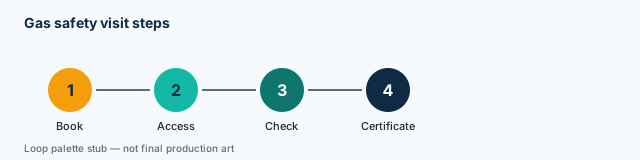
Aligns with hub `#guide` teaser; expands visit/prep detail for town pages.
- A Gas Safe registered engineer checks each gas appliance you provide (boiler, hob, fire, water heater) plus relevant flues, ventilation and pipework for safety.
- They look for gas tightness, correct operation, and anything that could cause carbon monoxide or other danger.
- You get a landlord gas safety record (the certificate). One record usually covers all appliances checked that day.
- The engineer should only issue the record once the checks are done. If something’s unsafe, they may disconnect or warn “Danger Do Not Use” — you then arrange remedial work. Keep notes of follow-up work alongside the record.
- LPG counts too. Off the gas grid with bottled or tank LPG? The yearly check still applies if you provide those appliances — book someone who covers LPG.
How long a typical visit takes
Times vary with how many appliances you have and how easy access is. Honest ranges, not guarantees:
- Often 30–60 minutes for a typical flat or small house with one boiler and a hob.
- Allow 45–90 minutes if there’s a gas fire, secondary heater, awkward cupboard, or LPG setup.
- Larger HMOs or multiple boilers take longer — ask when you book.
- Add buffer for parking, meter location, and tenant handover. Same-day digital copies are common; ask how you’ll receive the certificate.
What the landlord must have ready
- Access arranged with the tenant (or vacant possession). Put access rights in the tenancy agreement; don’t force entry.
- Clear path to the boiler, gas meter, cooker and any gas fire — cupboards emptied enough to work safely.
- Appliances switched on and usable (or tell the engineer if something’s isolated).
- Previous gas safety certificate / record if you have one (helps continuity).
- Landlord or agent name and address for the record (you don’t have to sign it, but details must appear).
- Working carbon monoxide alarm where rules require one (nation rules differ — see below).
- If off-grid: note whether it’s LPG so the right engineer is booked.
Tips to prepare
- Book early. You can usually have the check up to two months before the anniversary and keep the original deadline — useful for diary planning. Confirm current HSE guidance when you book.
- Tell tenants in writing the date and why it matters. If access fails, keep a paper trail of attempts (notes through the door, emails, offered rebooks).
- Check CO alarms work before the visit — better than finding a flat battery on the day.
- Don’t block vents or flues; clear laundry and storage from boiler cupboards.
- Between tenancies, confirm appliances left behind, open-ended pipes, or vandalism — HSE advises a fresh check before re-letting if anything looks tampered with.
- Keep records at least two years (longer if you use the early-check flexibility — see HSE). Electronic copies are fine if secure and printable.
How often it’s required
Friendly summary only — not legal advice. Rules can change. Use the official sources linked below before relying on this.
England
Friendly summary only — not legal advice. Rules can change. Use the official sources linked below.
GOV.UK — landlord safety responsibilities · HSE — gas safety records
HSE domestic FAQs (CO) · GOV.UK private renting guidance
- Arrange a gas safety check of appliances and flues you provide at least every 12 months, by a Gas Safe registered engineer (Gas Safety (Installation and Use) Regulations 1998).
- Give existing tenants a copy within 28 days of the check; give new tenants a copy before they move in. Keep records typically at least 2 years.
- From October 2022, a CO alarm is generally required in rooms used as living accommodation with a fixed combustion appliance (excluding gas cookers). Confirm current wording.
Rules in other UK nations
Wales
HSE landlord FAQs · gov.wales — Renting Homes (hub URL in rules.py: https://www.gov.wales/renting-homes — fetch was 404 on 26 Oct 2026; use live hub)
Fitness for human habitation — landlords · Rent Smart Wales guidance on gov.wales
- Annual gas safety checks by a Gas Safe registered engineer remain required under the same UK gas regulations.
- Under Fitness for Human Habitation, a carbon monoxide alarm is generally required where there is a gas, oil or solid fuel appliance. Private landlords/agents must also meet Rent Smart Wales registration/licensing where applicable.
Scotland
mygov.scot — landlord repairs · HSE gas safety records
mygov.scot — landlord responsibilities · Scottish Government Repairing Standard guidance
- Annual gas safety check by a Gas Safe registered engineer; provide the certificate to new tenants before move-in and to existing tenants within 28 days (same GSIUR framework).
- A carbon monoxide detector is required where there is a fixed combustion appliance or flue (Repairing Standard). Landlords must register with the local council before letting.
Northern Ireland
nidirect — health and safety in rented accommodation · DfC landlord checklist
same nidirect / DfC links above
- Annual gas safety checks by a Gas Safe registered engineer; keep the record at least two years; give tenants the record (new tenants within 28 days of tenancy start per DfC checklist wording — confirm against nidirect).
- Register with the Landlord Registration Scheme. Fit CO detectors as required for new/replacement fuel-burning appliances.
Official sources
Official references (opened / checked 26 Oct 2026) — not a substitute for the full text on those sites.
Common questions
- How long does a landlord gas safety check take?
- How often do landlords need a gas safety certificate?
- What is a CP12 / landlord gas safety record?
- Do I need a gas safety certificate if the property is on LPG?
- When do I give tenants a copy of the gas safety certificate?
- How long should I keep gas safety records?
- What if my tenant won’t let the engineer in?
- Do landlords need a carbon monoxide alarm as well as a gas safety certificate?
Answers sit in the sections above and on the Gas safety (CP12) hub FAQ.
England rules in brief
Within 28 days: give your tenants a copy (new tenants get it before they move in). Keep it: hang on to records for at least 2 years. Also see landlord rules for Loughborough. Full Gas safety (CP12) rules by nation · Quick guide · GOV.UK.
Frequently asked questions
Nobody covers my part of Loughborough yet. Where else can I look?
The nearest other towns we list are Hathern (~2 miles), Barrow upon Soar (~3 miles), Long Whatton (~3 miles), measured straight-line between OS Open Names centres. A gas safety engineer based there may travel, so ask.
More questions about gas safety certificates? See the Gas safety (CP12) FAQ.
Letting in England? Free, sourced landlord guides and a certificate renewal tracker →
📊 The numbers behind this page
ONS Census 2021 figures here are for Loughborough itself (output areas added up to the town's boundary).
Figures in the text above name their source.
- Households on oil heating only
- 0.2% 1
- Households on district/communal heat networks
- 0.4% 1
- Usual residents (Census 2021)
- 64,860 2
- Homes built before 1919
- 14.5% 3
- ONS Census 2021, TS046
- ONS Census 2021
- VOA council tax stock 2025 (CTSOP4.1)
Data sources · updated 26 October 2026