
East Midlands · England
EPC (energy performance certificate) in Derby
What you need: A valid energy performance certificate from an accredited assessor before you let, with a copy for your tenants.
How often: When you let: you need a valid EPC, usually good for 10 years.
Free to use · No sign-up · Always check their registration before you book · Search another town or postcode
Landlord rules that apply in Derby (England)
- When you let: you need a valid EPC, usually good for 10 years.
- Minimum E: most private lets need E or better, unless exempt.
- Renters’ Rights Act 2025: England-only reforms (assured periodic tenancies from 1 May 2026). Overview on GOV.UK.
- Local licensing (Derby): mandatory HMO licensing applies (5+ people, 2+ households sharing facilities). Confirm any selective or additional scheme for your postcode with Derby council.
Short local summary — not legal advice. Full Energy Performance Certificate (EPC) rules by nation · Free landlord guides · GOV.UK landlord safety responsibilities
Request an EPC in Derby
No EPC assessor listed here yet. Tell us what you need and we'll find you a registered EPC assessor, free. Request an EPC
Check they're registered: GOV.UK: get a new energy certificate · GOV.UK: find an energy certificate
Local tips for Derby
Terrace and semi country
Most homes here are terraces or semis. Insulation and heating upgrades are the usual way to nudge a rating up, so have receipts ready.
Where's this from?
ONS Census 2021, Derby: 21.5% terraced, 38.7% semi-detachedOwn your home? This is for you too.
It's not just for landlords. Homeowners and buyers use these checks for peace of mind too.
Where's this from?
ONS Census 2021, Derby: 60.1% owner-occupiedRenting in Derby: the local picture
The housing mix in Derby is 25.5% detached, 38.7% semi-detached, 21.5% terraced and 11.7% purpose-built flats (Census 2021).
With 20.7% of households renting privately, minimum energy efficiency rules affect a typical share of local homes. 6.9% are heated by electricity only, which strongly affects EPC ratings.
18.2% of 111,151 households rent from a council or housing association, against 17.1% across England.
Source: ONS Census 2021 (town figures).
| Type | Share | Households |
|---|---|---|
| Mains gas | 81.6% | 90,651 |
| Two or more | 7.9% | 8,740 |
| Electric | 6.9% | 7,693 |
| Other / none | 3.2% | 3,566 |
Source: ONS Census 2021 (TS046) — Derby built-up area, Derby. OGL v3.
Getting to know Derby
Derby is in the Derby council area, in the East Midlands. On the council's ward map it takes in Alvaston North, Darley, Chellaston & Shelton Lock, Mickleover, Normanton, Mackworth & New Zealand, Abbey, Blagreaves, Alvaston South, Allestree, Oakwood and Arboretum wards.
Postcode-wise, Derby spans 10 districts: DE1 (Derby city centre), about 6,989 households; DE3 (Mickleover), about 7,191 households; DE21 (Chaddesden, Oakwood, Spondon and Breadsall), about 23,870 households; DE22 (Allestree, Darley Abbey, Mackworth Estate and Kedleston), about 20,078 households; DE23 (Heatherton Village, Littleover, Normanton and Pear Tree), about 21,687 households; DE24 (Allenton, Alvaston, Boulton and Osmaston), about 22,587 households; DE65 (Burnaston, Egginton, Etwall and Findern), about 9,147 households; DE72 (Ambaston, Aston-on-Trent, Borrowash and Breaston), about 8,924 households (2011 Census households, via Doogal). The same districts also take in Ash, Aston upon Trent, Barrow upon Trent, Barton Blount, Bearwardcote, Breadsall, Breaston, Breedon on the Hill, Burnaston, Calke, Castle Donington, Church Broughton, Dale Abbey and Draycott and Church Wilne, so an EPC assessor covering Derby will often know those streets too.
Next-door postcode districts: DE56 (Ambergate); DE7 (Horsley Woodhouse); DE14 (Branston); DE15 (Bretby); DE13 (Alrewas); DE6 (Ashbourne).
Ward by ward, Derby isn't all the same. Of its 23 main wards, private renting is highest in Arboretum (43% of households) and lowest in Aston (8%). For detached homes, Etwall leads (62%) and Arboretum has the fewest (7%). (ONS Census 2021, output areas summed to 2025 wards inside the town.)
Want more choice? The nearest bigger towns are Sheffield (~32 miles north) and Birmingham (~34 miles south-west), and accredited domestic energy assessors based there may travel.
How old are the homes? Council tax records put 16% of Derby's homes before 1919 and 16% since 2000 (England: 20% and 18%), so the housing here is close to the England average. The biggest slice was built between 1973 and 1999 (25%). Newer homes usually start from a better EPC rating, but check the certificate is still valid. (VOA council tax stock, 2025.)
Coverage around Derby
● Town centre · ● Nearby villages · Chip = postcode district
Schematic coverage for landlords — not a street map. Place names from OS Open Names / ONS (OGL).
Your corner of Derby
The middle of Derby is in the DE1 postcode district. Source: ONS Postcode Directory, nearest postcode to the built-up area centre.
Nearby towns
Other checks in Derby
New to EPC in Derby?
Need an EPC before you advertise in Derby? Here’s what the assessor does, how long a visit takes, and how long the certificate usually lasts.
An Energy Performance Certificate rates how energy-efficient a home is on an A–G scale and lists recommended improvements. You’ll need a valid EPC when you market or let most rented homes. It’s not a “boiler MOT” — it’s a snapshot of the building’s fabric and fixed systems, produced by an accredited assessor.
What’s involved
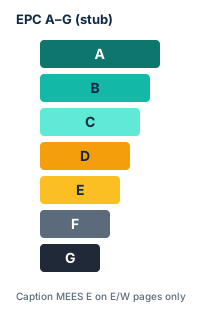
- An accredited domestic energy assessor visits, measures, and records walls, floors, roof, windows, heating, controls, lighting and so on.
- They lodge the certificate on the official register. You get a digital EPC with a rating and a recommendations list.
- Adverts should show the rating where required. Prospective tenants should be able to see the certificate; the person who becomes the tenant gets it free of charge.
- The recommendations table is your shopping list for improvements — useful for MEES (minimum standards) in England and Wales, and for comfort and bills everywhere.
- Never guarantee a band. Improvements can help a rating; they don’t promise a letter until a new assessment is lodged.
How long a typical visit takes
- Often 30–60 minutes for a typical flat or small terraced house.
- Often 45–90 minutes for a larger house, complex heating, loft conversions, or hard-to-measure extensions.
- The assessor needs access to the loft hatch, heating controls, boiler, and all rooms — empty cupboards help more than you’d think.
- Lodgement is usually same day or shortly after; you can check the register once it’s live.
What the landlord must have ready
- Full access (or tenant agreed access) including loft, boiler cupboard, and meters.
- Age/type of extensions or conversions if you know them; any previous EPC reference number.
- Heating fuel type (mains gas, oil, LPG, electric, heat pump) — especially important in off-grid towns.
- Confirmation whether the property is being marketed to let (you generally need a valid EPC before marketing).
- In Scotland, note display / provision rules differ slightly — check mygov.scot / gov.scot.
Tips to prepare
Cheap or easy wins that often help an assessment (no band promised):
- Fit LED bulbs in landlord-supplied fittings before the visit.
- Add or top up hot-water cylinder insulation if you have a tank (cheap jacket).
- Fix obvious draughts around loft hatches and unused chimneys (appropriate caps / blockers — don’t block required ventilation for fuel appliances).
- Make sure heating controls work and are accessible (room thermostat, TRVs, programmer).
- Clear the loft so insulation depth can be seen and measured.
- After improvements that matter (insulation, boiler, glazing, heat pump), commission a new EPC if you need the register to show a better rating for MEES or marketing.
- For England & Wales MEES: if you’re below E, read the official landlord guidance on the £3,500 cost cap and exemptions register before you spend.
How often it’s required
Friendly summary only — not legal advice. Rules can change. Use the official sources linked below before relying on this.
England
Friendly summary only — not legal advice. EPC rules and minimum standards differ by nation and are changing in places. Verify before you rely on this.
GOV.UK selling a home — EPCs · GOV.UK find an energy certificate · EPC dwellings guide
- An EPC is generally needed when a home is built, sold or rented, and is generally valid for 10 years (or until a newer EPC is lodged).
- MEES: privately rented homes covered by the regulations generally need at least band E unless a valid exemption is registered. Since April 2020 this applies to continuing lets as well as new ones. Government has signalled interest in a longer-term path toward higher bands — check current policy; don’t assume a future C duty is already law.
Rules in other UK nations
Wales
MEES guidance (applies England & Wales) · gov.wales Renting Homes materials · checklist on gov.wales
- Provide a valid EPC to contract-holders; MEES minimum E generally applies to private lets on the England & Wales framework. Renting Homes / occupation contracts apply from December 2022.
Scotland
mygov.scot — when you need an EPC · Scottish EPC Register · gov.scot EPC guide
gov.scot EPC publications · mygov.scot EPC pages — do not invent a live PRS minimum band.
- Make a valid EPC available when letting to a new tenant (including many short-term lets). Check the Scottish EPC Register. Historically EPCs have been valid for 10 years.
- Minimum energy standards for private rented homes have been proposed / consulted on but are not simply “band E like England”. Scottish Government correspondence in 2026 indicated PRS minimum standards wait on EPC reform clarity. Separately, EPC reform (new ratings, shorter validity) has been planned — check live gov.scot / mygov.scot before marketing, especially around late 2026 commencement talk.
Northern Ireland
DfC landlord checklist · GOV.UK get / find energy certificate (England, Wales & NI assessor search) · DoF NI EPC FAQs
DoF Energy Performance Certificates FAQs
- A valid EPC is required before advertising a private rental; lodge on the NI register and provide the certificate / report to viewers.
- Validity is generally 10 years on the same UK EPC model unless NI guidance says otherwise — see finance-ni / nidirect when you renew.
Official sources
Official references (opened / checked 26 Oct 2026) — not a substitute for the full text on those sites.
Common questions
- How long is an EPC valid?
- Do landlords need an EPC before advertising a rental?
- What is the minimum EPC rating for private rented homes?
- How long does an EPC assessment take?
- Can I improve my EPC rating cheaply before the assessor visits?
- Where do I find an existing energy certificate?
- Does Scotland have the same EPC minimum as England?
- What does an Energy Performance Certificate include?
Answers sit in the sections above and on the Energy Performance Certificate (EPC) hub FAQ.
England rules in brief
Minimum E: most private lets need E or better, unless exempt. Also see landlord rules for Derby. Full Energy Performance Certificate (EPC) rules by nation · Quick guide · GOV.UK.
Frequently asked questions
Is renting common in Derby?
Yes, about 21% of households rented privately at the 2021 Census (ONS TS054), so plenty of local landlords need these checks.
Nobody covers my part of Derby yet. Where else can I look?
The nearest other towns we list are Borrowash (~4 miles), Little Eaton (~4 miles), Quarndon (~4 miles), measured straight-line between OS Open Names centres. An EPC assessor based there may travel, so ask.
More questions about EPCs? See the Energy Performance Certificate (EPC) FAQ.
Letting in England? Free, sourced landlord guides and a certificate renewal tracker →
📊 The numbers behind this page
ONS Census 2021 figures here are for Derby itself (output areas added up to the town's boundary).
Figures in the text above name their source.
- Usual residents (Census 2021)
- 275,575 1
- Homes built before 1919
- 16.3% 2
- ONS Census 2021
- VOA council tax stock 2025 (CTSOP4.1)
Data sources · updated 26 October 2026