
Llandrindod Wells · Wales
EICR (electrical safety certificate) in Llandrindod Wells
What you need: An electrical installation condition report (EICR) on the wiring, from a qualified electrician, with a copy for the contract-holder.
Also covering: Llanwrtyd Wells, Crossgates, Newbridge-on-Wye, Llanyre.
How often: Every 5 years: an electrical safety test.
Free to use · No sign-up · Always check their registration before you book · Search another town or postcode
Landlord rules that apply in Llandrindod Wells (Wales)
- Every 5 years: an electrical safety test.
- Copy: give the contract-holder the report.
- Register: with Rent Smart Wales.
- Rent Smart Wales: private landlords must register, and anyone who manages must be licensed. Rent Smart Wales.
- Renting Homes (Wales) Act 2016: most private lets are occupation contracts with a written statement. Guide on GOV.WALES.
Wales-specific summary — not legal advice. Do not apply England-only Renters’ Rights wording here. Full Electrical safety (EICR) rules by nation · Free landlord guides
Request an EICR in Llandrindod Wells
No electrician listed here yet. Tell us what you need and we'll find you a registered electrician, free. Request an EICR
Check they're registered: Electrical Competent Person register · NICEIC contractor search · NAPIT installer search
Local tips for Llandrindod Wells
Flats and shared houses
Plenty of Llandrindod Wells homes are flats or converted houses, where the shared hallway lights and circuits matter too. Ask whether the quote covers communal areas.
Where's this from?
ONS Census 2021, Llandrindod Wells: 17.4% purpose-built flats, 6.9% converted/sharedBusy rental market: book early
Lots of people rent in Llandrindod Wells, so if you're letting, book a few weeks before a tenancy starts or renews. No last-minute panic.
Where's this from?
ONS Census 2021, Llandrindod Wells: 27.5% private rented vs 17.0% WalesRenting in Llandrindod Wells: the local picture
27.5% of households in Llandrindod Wells rent privately (above the Wales average of 17.0%), and private lets are covered by periodic electrical inspection rules.
17.4% live in purpose-built flats and 6.9% in converted or shared houses, including bedsits - property types where communal and individual circuits are often both in scope.
Homes in Llandrindod Wells: 29.4% detached, 26.7% semi-detached, 15.5% terraced and 17.4% purpose-built flats (Wales: 28.5%, 32.1%, 26.6% and 9.4%).
Source: ONS Census 2021 (town figures).
| Type | Share | Households |
|---|---|---|
| Mains gas | 74.6% | 2,023 |
| Two or more | 8.3% | 224 |
| Electric | 10.1% | 275 |
| Oil / LPG | 4.2% | 115 |
| Other / none | 2.8% | 75 |
Source: ONS Census 2021 (TS046) — Llandrindod Wells built-up area, Powys. OGL v3.
Getting to know Llandrindod Wells
Llandrindod Wells is in the Powys council area, Wales. On the council's ward map it takes in Llandrindod South and Llandrindod North wards.
Postcode-wise, Llandrindod Wells spans 3 districts: LD1, about 5,118 households; LD4 (Llangammarch Wells), about 373 households; LD5 (Llanwrtyd Wells), about 486 households (2011 Census households, via Doogal). The same districts also take in Abbey Cwmhir, Cilmery, Disserth and Trecoed, Glascwm, Llanafanfawr, Llanbadarn Fawr, Llanbadarn Fynydd, Llanbister, Llanddewi Ystradenny, Llanfihangel Rhydithon, Llangamarch, Llangunllo, Llanwrthwl and Llanwrtyd Wells, so an electrician covering Llandrindod Wells will often know those streets too.
Living just outside? This page also covers the smaller places nearby: Llanwrtyd Wells (~14 miles south-west), Crossgates (~3 miles north-east), Newbridge-on-Wye (~3 miles south-west) and Llanyre (~1 mile north-west).
Next-door postcode districts: LD2 (Builth Wells); LD6 (Rhayader); LD3 (Brecon); SY16 (Newtown); LD8 (Presteigne); SY17 (Caersws).
Ward by ward, Llandrindod Wells isn't all the same. Of its 2 main wards, private renting is highest in Llandrindod South (34% of households) and lowest in Llandrindod North (17%). For purpose-built flats, Llandrindod South leads (25%) and Llandrindod North has the fewest (3%). (ONS Census 2021, output areas summed to 2025 wards inside the town.)
Want more choice? The nearest bigger towns are Newtown (~18 miles north) and Aberystwyth (~32 miles west), and qualified electricians based there may travel.
Coverage around Llandrindod Wells
● Town centre · ● Nearby villages · Chip = postcode district
Also covering: Llanwrtyd Wells · Crossgates · Newbridge-on-Wye · Llanyre
Schematic coverage for landlords — not a street map. Place names from OS Open Names / ONS (OGL).
Your corner of Llandrindod Wells
The middle of Llandrindod Wells is in the LD1 postcode district. Source: ONS Postcode Directory, nearest postcode to the built-up area centre.
Nearby towns
Other checks in Llandrindod Wells
New to EICR in Llandrindod Wells?
First EICR for your Llandrindod Wells let? Here’s what the inspection covers, how long it takes, and how often it’s due — in plain English, with links to check.
An Electrical Installation Condition Report (EICR) is the formal report after a qualified person inspects and tests the fixed electrics in your let — wiring, sockets, lights, consumer unit (fuse box), and permanently connected kit. In plain terms: “Are these electrics safe to keep using?” You’ll also hear “electrical safety certificate” in everyday speech; the document you’re after is usually the EICR (or, for a brand-new install, an Electrical Installation Certificate).
What’s involved
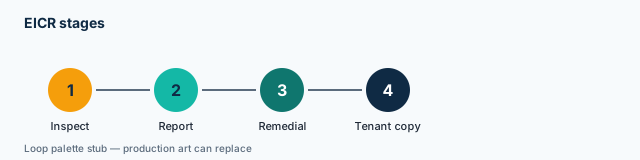
- A qualified person inspects and tests the fixed electrical installation against BS 7671 (Wiring Regulations).
- They look for overload, shock and fire risks, defective work, and weak earthing or bonding.
- You receive a report (usually an EICR) with a satisfactory / unsatisfactory outcome and a next-inspection date.
- Classification codes you’ll see: C1 (danger present), C2 (potentially dangerous), C3 (improvement recommended), FI (further investigation). C1/C2/FI generally mean remedial or further work is needed for a satisfactory outcome; C3 alone is recommendation, not usually a fail.
- Scotland also expects PAT / in-service testing of appliances you supply, alongside the installation report.
- Communal corridors in a block are usually outside the PRS EICR rules for your flat — but you still need safe communal electrics under other housing law. Ask your freeholder/managing agent who’s responsible.
How long a typical visit takes
Honest ranges — ask your electrician for a quote timed to your property:
- Often 2–4 hours for a typical 1–2 bed flat with straightforward access to the consumer unit.
- Often 3–6 hours for a 3–4 bed house, older wiring, or more circuits.
- Larger HMOs, multiple consumer units, or solar/battery systems can run longer or need a specialist second visit.
- Power may be off for parts of the test — warn tenants. Remedial work is usually a separate booking.
What the landlord must have ready
- Access to every room, loft (if relevant), and the consumer unit — clear the cupboard; labels help.
- Keys for meter cupboards / communal intake if you hold them.
- The previous EICR (or Electrical Installation Certificate for a rewire) so the next inspector can pick up history.
- List of landlord-supplied appliances (especially in Scotland, where PAT is expected).
- Tenant notice: testing means switching circuits off; agree a window that works for them.
- Any known DIY electrical work, extensions, or EV charger installs — flag them up front.
Tips to prepare
- Make the consumer unit reachable without moving a fridge or climbing over bikes.
- Replace cracked sockets and missing blanking plates before the visit if you can — small fixes often prevent codes.
- Don’t overload extensions as a long-term “solution”; the inspection will notice.
- After the report: diary C1/C2/FI deadlines (often within 28 days in England — confirm). Keep written confirmation of remedial work for tenants and, if asked, the council.
- Visual walk-round between tenancies (scorch marks, loose fittings) — not a substitute for the EICR, but catches obvious issues early.
- Ask which competent person scheme the electrician belongs to, then look them up before they arrive.
How often it’s required
Friendly summary only — not legal advice. Rules can change. Use the official sources linked below before relying on this.
Wales
Fitness of homes for human habitation — landlords · Renting Homes checklist
gov.wales Renting Homes hub
- Fitness for Human Habitation regulations require electrical safety testing at least every 5 years (sooner if the previous report says so). Provide the electrical condition report to the contract-holder (commonly within 14 days of occupation or of the inspection — confirm current FFHH wording).
- Rent Smart Wales registration / licensing still applies to private landlords and agents.
Rules in other UK nations
England
Friendly summary only — not legal advice. Rules differ by nation and can change. Use the official sources linked below.
GOV.UK electrical safety standards guidance
same GOV.UK guidance
- Under the Electrical Safety Standards in the Private Rented Sector (England) Regulations 2020 (updated for social housing in 2025), private landlords must have installations inspected and tested by a qualified person at least every 5 years (or sooner if the report says so).
- Give existing tenants a copy within 28 days; new tenants before occupation; prospective tenants within 28 days of a request; local authority within 7 days if requested. Complete required remedial / further investigation within 28 days (or any shorter period on the report).
- A full Electrical Installation Certificate for a new build or complete rewire can cover you for five years in place of an immediate EICR — confirm against the guidance.
Scotland
mygov.scot — landlord repairs · Repairing Standard statutory guidance — electricity
mygov.scot — what to give a tenant
- Under the Repairing Standard, landlords must arrange an electrical safety inspection (periodic inspection and testing of the installation plus in-service testing of landlord-supplied equipment) before first let and then at least every 5 years. An RCD in the main consumer unit is expected.
- Give new tenants the electrical report and PAT report (with other move-in documents). Interlinked smoke and heat alarms have applied since February 2022 — check current alarm rules separately.
Northern Ireland
nidirect — health and safety · legislation.gov.uk NISR 2024/201 · DfC landlord materials
- Electrical installations must be inspected and tested by a qualified person at least every 5 years. The Electrical Safety Standards for Private Tenancies Regulations (Northern Ireland) 2024 set duties for private landlords (report to tenants within 28 days; remedial timelines similar to England). Confirm commencement / application dates for your tenancy type — don’t assume every older tenancy is already in scope without checking.
- Landlord Registration Scheme registration still applies.
Official sources
Official references (opened / checked 26 Oct 2026) — not a substitute for the full text on those sites.
Common questions
- How often does a landlord need an EICR?
- How long does an electrical safety inspection take?
- What is the difference between an EICR and an electrical installation certificate?
- What do C1, C2 and C3 mean on an EICR?
- Do landlords have to give tenants a copy of the EICR?
- Do I need PAT testing as well as an EICR?
- What if the EICR is unsatisfactory?
- Who can carry out a landlord electrical safety inspection?
Answers sit in the sections above and on the Electrical safety (EICR) hub FAQ.
Wales rules in brief
Copy: give the contract-holder the report. Register: with Rent Smart Wales. Also see landlord rules for Llandrindod Wells. Full Electrical safety (EICR) rules by nation · Quick guide · GOV.WALES.
Frequently asked questions
Is renting common in Llandrindod Wells?
Yes, about 28% of households rented privately at the 2021 Census (ONS TS054), so plenty of local landlords need these checks.
Nobody covers my part of Llandrindod Wells yet. Where else can I look?
The nearest other towns we list are Builth Wells (~7 miles), Rhayader (~7 miles), Kington (~15 miles), measured straight-line between OS Open Names centres. An electrician based there may travel, so ask.
More questions about EICRs? See the Electrical safety (EICR) FAQ.
Letting in Wales? Free, sourced landlord guides and a certificate renewal tracker →
📊 The numbers behind this page
ONS Census 2021 figures here are for Llandrindod Wells itself (output areas added up to the town's boundary).
Figures in the text above name their source.
- Households with electric-only heating
- 10.1% 1
- Usual residents (Census 2021)
- 5,430 2
- ONS Census 2021, TS046
- ONS Census 2021
Data sources · updated 26 October 2026